ARTICLES OF THE CHRISTIAN RELIGION

lunedì 13 aprile 2009

Jesus went into the temple of God, and cast out all them that sold and bought in the temple


Jesus went into the temple of God, and cast out all them that sold and bought in the temple


The Gospel of Matthew
21: 1-17
[1] And when they drew nigh unto Jerusalem, and were come to Bethphage, unto the mount of Olives, then sent Jesus two disciples,
[2] Saying unto them, Go into the village over against you, and straightway ye shall find an ass tied, and a colt with her: loose them, and bring them unto me.
[3] And if any man say ought unto you, ye shall say, The Lord hath need of them; and straightway he will send them.
[4] All this was done, that it might be fulfilled which was spoken by the prophet, saying,
[5] Tell ye the daughter of Sion, Behold, thy King cometh unto thee, meek, and sitting upon an ass, and a colt the foal of an ass.
[6] And the disciples went, and did as Jesus commanded them,
[7] And brought the ass, and the colt, and put on them their clothes, and they set him thereon.
[8] And a very great multitude spread their garments in the way; others cut down branches from the trees, and strawed them in the way.
[9] And the multitudes that went before, and that followed, cried, saying, Hosanna to the Son of David: Blessed is he that cometh in the name of the Lord; Hosanna in the highest.
[10] And when he was come into Jerusalem, all the city was moved, saying, Who is this?
[11] And the multitude said, This is Jesus the prophet of Nazareth of Galilee.
[12] And Jesus went into the temple of God, and cast out all them that sold and bought in the temple, and overthrew the tables of the moneychangers, and the seats of them that sold doves,
[13] And said unto them, It is written, My house shall be called the house of prayer; but ye have made it a den of thieves.
[14] And the blind and the lame came to him in the temple; and he healed them.
[15] And when the chief priests and scribes saw the wonderful things that he did, and the children crying in the temple, and saying, Hosanna to the Son of David; they were sore displeased,
[16] And said unto him, Hearest thou what these say? And Jesus saith unto them, Yea; have ye never read, Out of the mouth of babes and sucklings thou hast perfected praise?
[17] And he left them, and went out of the city into Bethany; and he lodged there.

http://www.earlychristianwritings.com/text/matthew-kjv.html

http://groups.google.com/group/christianbiblestudies?hl=it

domenica 29 marzo 2009

Blasphemy Against the Holy Spirit—The “Unpardonable Sin”


Blasphemy Against the Holy Spirit—The “Unpardonable Sin”
by Kyle Butt, M.A.


Printer version | Email this article


Through the years, numerous writers have taken on the task of explaining the comment spoken by Jesus concerning the “unpardonable sin”—blasphemy against the Holy Spirit. From these writings have come countless false doctrines, insinuations, and suggested explanations. It is the purpose of this article to explain what “blasphemy against the Holy Spirit” is not, what it actually is, and to offer comment concerning whether it still can be committed today.

Three of the four gospel accounts contain a reference to the statement made by Jesus concerning blasphemy against the Holy Spirit. These three passages read as follows.

Therefore I say to you, every sin and blasphemy will be forgiven men, but the blasphemy against the Spirit will not be forgiven men. Anyone who speaks a word against the Son of Man, it will be forgiven him; but whoever speaks against the Holy Spirit, it will not be forgiven him, either in this age or in the age to come (Matthew 12:31-32).

Assuredly, I say to you, all sins will be forgiven the sons of men, and whatever blasphemies they may utter; but he who blasphemes against the Holy Spirit never has forgiveness, but is subject to eternal condemnation—because they said, “He has an unclean spirit” (Mark 3:28-30).

And anyone who speaks a word against the Son of Man, it will be forgiven him; but to him who blasphemes against the Holy Spirit, it will not be forgiven (Luke 12:10).

Each of these references to the statement made by Jesus verifies that Jesus did clearly state that there is a specific sin that “will not be forgiven.” The American Standard Version describes the sin as an “eternal sin” (Mark 3:29). Jesus defined that sin as “the blasphemy against the Spirit.” What, then, is blasphemy against the Spirit?

In order to explain this sin fully, a look at the general context of the statement is critical. Matthew’s account offers the most detail concerning the setting in which Jesus’ statement was made. In Matthew 12:22, the text indicates that a certain man who was demon-possessed was brought to Jesus to be healed. As was His common practice, Jesus cast out the unclean spirit, and healed the man of his blindness and inability to speak. After seeing this display of power, the multitudes that followed Jesus asked, “Could this be the Son of David?” (12:23). Upon hearing this remark, the Pharisees, wanting to discredit the source from which Jesus received His power, declared that Jesus was casting out demons by “Beelzebub, the ruler of demons.” Jesus proceeded to explain that a kingdom divided against itself could not stand, and if He were casting out demons by the power of demons, then He would be defeating Himself. It was after this accusation by the Pharisees, and Jesus’ defense of His actions, that Christ commented concerning the blasphemy against the Spirit. In fact, the text of Mark clearly states that Jesus made the comment about the blasphemy against the Spirit “because they said, ‘He has an unclean spirit.’ ”

Another critical piece of information needed to clarify Jesus’ statement is the definition of blasphemy. Wayne Jackson wrote: “Blasphemy is an anglicized form of the Greek term blasphemia, which scholars believe probably derives from two roots, blapto, to injure, and pheme, to speak. The word would thus suggest injurious speech” (2000). Bernard Franklin, in his article concerning blasphemy against the Spirit, suggested:

The word “blasphemy” in its various forms (as verb, noun, adjective, etc.) appears some fifty-nine times in the New Testament. It has a variety of renderings, such as, “blasphemy,” “reviled,” “railed,” “evil spoken of,” “to speak evil of,” etc. Examples of these various renderings are: “They that passed by reviled him” (Matthew 27:39). “He that shall blaspheme” (Mark 3:29). “They that passed by railed on him” (Mark 15:29). “The way of truth shall be evil spoken of ” (2 Peter 2:2). “These speak evil of those things” (Jude 10). It is evident from these that blasphemy is a sin of the mouth, a “tongue-sin.” All New Testament writers except the author of Hebrews use the word (1936, pp. 224-225).

Furthermore, Jesus defined the term when, after referring to blasphemy, He used the phrase “speaks a word against” in Matthew 12:32.

WHAT THE UNPARDONABLE SIN IS NOT

With the working definition of blasphemy meaning, “to speak against,” or “speak evil of,” it is easy to rule out several sins that would not qualify as the unpardonable sin. Occasionally, murder is suggested as the “unpardonable sin.” Such cannot be the case, however. First, since blasphemy is a “tongue sin,” murder would not fall into this category. Second, several biblical passages show the sin of murder can be forgiven. When King David committed adultery and had Uriah the Hittite murdered, the prophet Nathan came to him, informing him that God had seen that David “killed Uriah the Hittite with the sword” (2 Samuel 12:9). When David confessed to Nathan and repented, the prophet told David, “The Lord also has put away your sin; you shall not die” (12:13). And, although David was punished for his iniquity, it was forgiven. The Bible plainly demonstrates that murder is not the unpardonable sin.

Adultery surfaces as another sin put forward as unpardonable. Yet the same reasoning used to discount murder as the unpardonable sin can be used to disqualify adultery. First, it does not fit the category of blasphemy. Second, David was forgiven of adultery, just as surely as he was forgiven of murder. The apostle Paul gave a list of no less than ten sins (including adultery) of which the Corinthian brethren had been forgiven (1 Corinthians 6:9-11). Adultery cannot be the unpardonable sin.

Another sin set forth as the unpardonable sin is blasphemy of any kind, not specifically against the Holy Spirit. We know, however, that blasphemy in general cannot be unforgivable for two reasons. First, in the context of the unpardonable sin, Jesus clearly stated that “whatever blasphemies” men may utter (besides against the Holy Spirit) could be forgiven. Second, Paul confessed that before his conversion, he had formerly been “a blasphemer, a persecutor, and an insolent man; but I obtained mercy because I did it ignorantly in unbelief ” (1 Timothy 1:13). These two biblical passages rule out the possibility of general blasphemy as the unpardonable sin.

We begin to see, then, that we cannot arbitrarily decide which sins we think are heinous, and then simply attribute to them the property of being unpardonable, especially considering the fact that even those who were guilty of crucifying the Son of God had the opportunity to be forgiven (Acts 2:36-38). Therefore, since the unpardonable sin falls into a category of its own, and cannot be murder, adultery, general blasphemy, etc., some scholars have set forth the idea that the unpardonable sin is not a single sin at all, but is instead the stubborn condition of a person who persists in unbelief. This understanding, however, fails to take into account the immediate context of the “unpardonable sin.” Gus Nichols, commenting on this idea of “persistent unbelief,” stated: “It is true, great multitudes are going into eternity in rebellion against God to be finally and eternally lost; but it is for rejecting and neglecting pardon graciously extended in the gospel while they live, not because they have committed the unpardonable sin” (1967, p. 236). Wendell Winkler, under a section titled, “What the Blasphemy Against the Holy Spirit is Not,” wrote that it is not

postponement of obedience until death. The text implies that those who commit the eternal sin continue to live while having lost all opportunity of salvation; whereas those who postpone obedience to Christ (except those who commit the eternal sin) could have obeyed at any time previous to their death (1980, p. 20).

IN THIS AGE OR IN THE AGE TO COME

Jesus said that blasphemy against the Spirit would not be forgiven “in this age or in the age to come” (Matthew 12:32). Certain religious organizations have seized upon this statement to suggest that Jesus has in mind a situation in which certain sins will be remitted after death—but not this sin. This idea of a purgatory-like state, where the souls of the dead are given a “second chance” to do penance for the sins they committed in their earthly life, finds no justification in this statement made by Christ (nor in any other biblical passage, for that matter). R.C.H. Lenski stated that Jesus’ use of the phrase under discussion meant simply “absolutely never” (1961, p. 484). Hendriksen concurred with Lenski when he wrote:

In passing, it should be pointed out that these words by no stretch of the imagination imply that for certain sins there will be forgiveness in the life hereafter. They do not in any sense whatever support the doctrine of purgatory. The expression simply means that the indicated sin will never be forgiven (1973, p. 528).

As the writer of Hebrews succinctly wrote, “it is appointed for men to die once, but after this the judgment” (Hebrews 9:27).

It also has been suggested by several writers that the “age to come” discussed by Jesus refers to the Christian Age. According to this idea, Jesus made the statement in the Jewish Age, when the Law of Moses was in effect, and the “age to come” denoted the Christian Age immediately following, when the Law of Christ would prevail. Putting this meaning to the phrase often leads the advocates of this theory to conclude that the unpardonable sin could be committed in the Christian Age, after the resurrection of Christ. As Winkler surmised, “Thus, since our Lord was speaking while the Jewish age was in existence, he was affirming that the blasphemy against the Holy Ghost would not be forgiven in (a) the Jewish age, nor in (b) the Christian age, the age that followed” (1980, p. 21). Nichols, after affirming the same proposition, concluded:

It follows that this sin, therefore, could be committed during the personal ministry of Christ, and was then committed, as we have seen, and could also be committed under the gospel age or dispensation. They could have attributed the works of the Spirit to Satan after Pentecost, the same as before (1967, p. 234).

Two primary pieces of evidence, however, militate against the idea that Jesus’ reference to the “age to come” meant the Christian Age. First, in Mark 10:30, the gospel writer has Jesus on record using the same phrase (“in the age to come”) to refer to the time when the followers of Christ would inherit “eternal life” (see Luke 18:30 for the parallel passage). This is a clear reference to life after death, since Paul said “flesh and blood cannot inherit the kingdom of God” (1 Corinthians 15:50). Second, Mark’s account of the unpardonable sin describes the sin as an “eternal sin.” The translators of the New King James Version recorded that the person who commits the sin “never has forgiveness, but is subject to eternal condemnation” (Mark 3:29). Mark’s account, with its emphasis on eternity, shows that the phrase simply is meant to underscore the fact that this sin will “absolutely never” be forgiven (Lenski, p. 484). It is incorrect, then, to use the phrase “in the age to come” to refer to purgatory. It also is tenuous to use the phrase to refer to the Christian Age. The best explanation, to quote Hendrickson again, is that “the expression simply means that the indicated sin will never be forgiven” (p. 528).

WHAT THE UNPARDONABLE SIN IS

As was noted earlier, blasphemy against the Holy Spirit is the only sin in the Bible that is given the status of unpardonable or eternal. In fact, Jesus prefaced His discussion of this sin by stating that, “every sin and blasphemy will be forgiven men,” except for blasphemy against the Spirit. Using the working definition of blasphemy as “speaking evil of,” it becomes clear that the sin described by Jesus was a “tongue sin” that the Pharisees had committed, or at least were dangerously close to committing.

What had the Pharisees done that would have put them in jeopardy of committing the unpardonable sin? According to His own testimony, during Jesus’ time on this Earth He cast out demons by the “Spirit of God” (Matthew 12:28). When the Pharisees saw that Jesus had performed a verifiable miracle, they could not argue with the fact that Christ possessed certain powers that others (including themselves) did not have. Therefore, in order to cast suspicion on the ministry of Jesus, they claimed that He was casting out demons by Beelzebub, the ruler of demons. The name Beelzebub is simply another name for Satan (Franklin, 1936, p. 227), as can be seen from Jesus’ reference to Satan in Matthew 12:26. Even when faced by the miraculous working of the Holy Spirit through Jesus, the Pharisees were, in essence, attributing Jesus’ power to Satan, and claiming that Jesus was “Satan incarnate instead of God incarnate. It is this, and nothing else, that our Lord calls the blasphemy against the Holy Ghost (or Spirit—KB)” (Franklin, p. 227). Maxie Boren wrote: “The context of Matthew 12:22ff. shows clearly that this was indeed the sin of blasphemy against the Holy Spirit—attributing the miracle done by Jesus to the power of the devil. Jesus said it was done ‘by the Spirit of God’ (verse 28) but they (the Pharisees—KB) said it was done by Beelzebub” (n.d., p. 1). It is clear that blasphemy against the Spirit was a definite, singular sin, which could be committed by the Pharisees during the life of Jesus.

IS THE “UNPARDONABLE SIN” THE
SAME AS THE “SIN UNTO DEATH”?

John, in his first epistle, mentioned the fact that “there is sin leading to death” and “there is sin not leading to death” (1 John 5:16-17). His statement in these verses has been connected by more than a few people to Jesus’ remark about the “eternal sin.” It is evident, however, that this connection is based more on opinion than on textual Bible study.

First, there is no biblical evidence that connects the passage in 1 John with the Pharisees’ accusation. Furthermore, the entire context of 1 John gives the Christian readers hope of forgiveness for all sins that they might have committed. John wrote: “All unrighteousness is sin, and there is sin not leading to death” (1 John 5:17). Several chapters earlier, he wrote: “If we confess our sins, He is faithful and just to forgive us our sins and to cleanse us from all unrighteousness (1 John 1:9, emp. added). In the scope of John’s epistle, any unrighteousness committed by his readers could be forgiven if the transgressor took the proper steps of repentance and confession. Apparently, the “sin unto death” in 1 John is not a specific sin for which it is impossible to receive forgiveness, but rather, is any sin for which a person will not take the proper steps demanded by God to receive the forgiveness available. On the other hand, blasphemy against the Spirit was a specific, eternal sin that never would be forgiven.

CAN THE UNPARDONABLE SIN BE COMMITTED TODAY?

The next question usually asked concerning this sin is whether or not it is still possible to commit it today. Opinions on this question certainly vary, and scholars seem to be divided in their positions. The evidence, however, seems to point toward the idea that this sin cannot be committed today.

First, the circumstances under which the sin is described cannot prevail today, due to the fact that the age of miracles has ceased (see Miller, 2003). No one today will have the opportunity to witness Jesus performing miracles in person (2 Corinthians 5:16).

Second, there is no other mention of the sin in any biblical passage written after the resurrection of Christ. None of the inspired New Testament writers refers to the sin in any epistle or in the book of Acts, and none offers warnings to new converts about avoiding the sin post-Pentecost. Franklin observed:

If it were possible for it to be committed, would there not have been some warning against it? Were there any danger regarding it, would the Apostle Paul, who wrote half the books of the New Testament, have failed to warn against its commission? Paul does not even mention the blasphemy against the Holy Spirit. The sin in question was actually committed in the days of our Lord’s ministry on earth, but it does not necessarily follow that it could be committed in His absence (p. 233).

In discussing this matter, Gus Nichols wrote: “It seems that all sins committed today are pardonable, and that all can be saved, if they will” (1967, p. 239). V.E. Howard, commented along the same lines when he stated that “there is no unpardonable sin today” (1975, p. 156).

In conclusion, blasphemy against the Holy Spirit is the only unpardonable sin mentioned in the Bible, and it is mentioned in the context of the Pharisees accusing Jesus of being possessed by the Devil. The context indicates that it was a specific sin, and not a series of forgivable sins, or an attitude of persistent unbelief. After the resurrection, no inspired writer mentions the sin, and no warnings against it were recorded. There is no concrete evidence that it can be committed today. The fact that it is not mentioned after the resurrection, lends itself to the idea that it cannot still be committed. In fact, the indication from passages such as 1 John 1:7,9 is that “all unrighteousness” that a person could commit today can be forgiven by the blood of Jesus. As Howard said when concluding his remarks about the eternal sin: “In the same scripture our Lord gave full assurance that every sin and blasphemy against the ‘Son of man’ shall be forgiven him. Today the gospel of Christ is to be preached to every man on earth and any man on earth may be saved by obeying the gospel (Mark 16:15-16)” [p. 157].

REFERENCES

Boren, Maxie B. (no date), “The Blasphemy Against the Holy Spirit,” Class Handout, Brown Trail church of Christ, Bedford, Texas, Lesson 4.

Franklin, Barnard (1936), “The Blasphemy Against the Holy Ghost: An Inquiry into the Scriptural Teaching Regarding the Unpardonable Sin,” Bibliotheca Sacra, 93:220-233, April.

Hendriksen, William (1973), The Gospel According to Matthew (Grand Rapids, MI: Baker).

Howard, V.E. (1975), The Holy Spirit (West Monroe, LA: Central Publishers).

Jackson, Wayne (2000), Blasphemy—What Is This Great Sin?, [On-line], URL: http://www.christiancourier.com/archives/blasphemy.htm.

Lenski, R.C.H. (1961 reprint), The Interpretation of St. Matthew’s Gospel (Minneapolis, MN: Augsburg).

Miller, Dave (2003), “Modern-day Miracles, Tongue-speaking, and Holy Spirit Baptism: A Refutation,” Reason and Revelation, 23(3):17-23, March.

Nichols, Gus (1967), Lectures on the Holy Spirit (Plainview, TX: Nichols Brothers).

Winkler, Wendell, ed. (1980), What Do You Know About the Holy Spirit? (Fort Worth, TX: Winkler Publications).


--------------------------------------------------------------------------------

Copyright © 2003 Apologetics Press, Inc. All rights reserved.
We are happy to grant permission for items in the "Scripturally Speaking" section to be reproduced in their entirety, as long as the following stipulations are observed: (1) Apologetics Press must be designated as the original publisher; (2) the specific Apologetics Press Web site URL must be noted; (3) the author’s name must remain attached to the materials; (4) any references, footnotes, or endnotes that accompany the article must be included with any written reproduction of the article; (5) alterations of any kind are strictly forbidden (e.g., photographs, charts, graphics, quotations, etc. must be reproduced exactly as they appear in the original); (6) serialization of written material (e.g., running an article in several parts) is permitted, as long as the whole of the material is made available, without editing, in a reasonable length of time; (7) articles, in whole or in part, may not be offered for sale or included in items offered for sale; and (8) articles may be reproduced in electronic form for posting on Web sites pending they are not edited or altered from their original content and that credit is given to Apologetics Press, including the web location from which the articles were taken.

For catalog, samples, or further information, contact:

Apologetics Press
230 Landmark Drive
Montgomery, Alabama 36117
U.S.A.
Phone (334) 272-8558
http://www.apologeticspress.org


Browse Scripturally Speaking Browse all articles


http://www.apologeticspress.org/articles/2272

lunedì 2 febbraio 2009

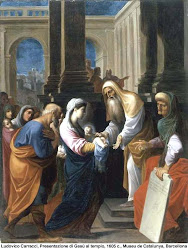
The Presentation of the Lord


* Monday, 2 February 2009
The Presentation of the Lord - Feast


Holy Gospel of Jesus Christ according to Saint Luke 2,22-40.

When the days were completed for their purification according to the law of Moses, they took him up to Jerusalem to present him to the Lord,
just as it is written in the law of the Lord, "Every male that opens the womb shall be consecrated to the Lord,"
and to offer the sacrifice of "a pair of turtledoves or two young pigeons," in accordance with the dictate in the law of the Lord.
Now there was a man in Jerusalem whose name was Simeon. This man was righteous and devout, awaiting the consolation of Israel, and the holy Spirit was upon him.
It had been revealed to him by the holy Spirit that he should not see death before he had seen the Messiah of the Lord.
He came in the Spirit into the temple; and when the parents brought in the child Jesus to perform the custom of the law in regard to him,
he took him into his arms and blessed God, saying:
Now, Master, you may let your servant go in peace, according to your word,
for my eyes have seen your salvation,
which you prepared in sight of all the peoples,
a light for revelation to the Gentiles, and glory for your people Israel."
The child's father and mother were amazed at what was said about him;
and Simeon blessed them and said to Mary his mother, "Behold, this child is destined for the fall and rise of many in Israel, and to be a sign that will be contradicted
(and you yourself a sword will pierce) so that the thoughts of many hearts may be revealed."
There was also a prophetess, Anna, the daughter of Phanuel, of the tribe of Asher. She was advanced in years, having lived seven years with her husband after her marriage,
and then as a widow until she was eighty-four. She never left the temple, but worshiped night and day with fasting and prayer.
And coming forward at that very time, she gave thanks to God and spoke about the child to all who were awaiting the redemption of Jerusalem.
When they had fulfilled all the prescriptions of the law of the Lord, they returned to Galilee, to their own town of Nazareth.
The child grew and became strong, filled with wisdom; and the favor of God was upon him.


02 February
--------------------------------------------------------------------------------


The Presentation of Child Jesus in the Temple


THE law of God, given by Moses to the Jews, ordained that a woman, after childbirth, should continue for a certain time in a state which that law calls unclean, during which she was not to appear in public, nor presume to touch anything consecrated to God. This term was of forty days upon the birth of a son, and double that time for a daughter. On the expiration of the term, the mother .vas to bring to the door of the tabernacle, or Temple, a lamb and a young pigeon, or turtle-dove, as an offering to God. These being sacrificed to Almighty God by the priest, the woman was cleansed of the legal impurity and reinstated in her former privileges.

A young pigeon, or turtle-dove, by way of a sin-offering, was required of all, whether rich or poor; but as the expense of a lamb might be too great for persons in poor circumstances, they were allowed to substitute for it a second dove.

Our Saviour having been conceived by the Holy Ghost, and His blessed Mother remaining always a spotless virgin, it is evident that she did not come under the law; but as the world was, as yet, ignorant of her miraculous conception, she submitted with great punctuality and exactness to every humbling circumstance which the law required. Devotion and mal to honor God, by every observance prescribed by His law, prompted Mary to perform this act of religion, though evidently exempt from the precept. Being poor herself, she made the offering appointed for the poor; but; however mean in itself, it was made with a perfect heart, which is what God chiefly regards in all that is offered to Him. Besides the law which obliged the mother to purify herself, there was another which ordered that the first-born son should be offered to God, and that, after its presentation, the child should be ransomed with a certain sum of money, and peculiar sacrifices offered on the occasion.

Mary complies exactly with all these ordinances. She obeys not only in the essential points of the law, but has strict regard to all the circumstances. She remains forty days at home; she denies herself, all this time, the liberty of entering the Temple; she partakes not of things sacred; and on the day of her purification she walks several miles to Jerusalem, with the world's Redeemer in her arms. She waits for the priest at the gate of the Temple, makes her offerings of thanksgiving and expiation, presents her divine Son by the hands of the priest to His Eternal Father, with the most profound humility, adoration, and thanksgiving. She then redeems Him with five shekels, as the law appoints, and receives Him back again as a sacred charge committed to her special care, till the Father shall again demand Him for the full accomplishment of man's redemption.

The ceremony of this day was closed by a third mystery—the meeting in the Temple of the holy persons Simeon and Anne with Jesus and His parents. Holy Simeon, on that occasion, received into his arms the object of all his desires and sighs, and praised God for being blessed with the happiness of beholding the so-much-longed-for Messias. Re foretold to Mary her martyrdom of sorrow, and that Jesus brought redemption to those who would accept of it on the terms it was offered them; but a heavy judgment on all infidels who should obstinately reject it, and on Christians, also, whose lives were a contradiction to His holy maxims and example. Mary, hearing this terrible prediction, did not answer one word, felt no agitation of mind from the present, no dread for the future; but courageously and sweetly committed all to God's holy will. Anne, also, the prophetess, who in her widowhood served God with great fervor, had the happiness to acknowledge and adore in this great mystery the Redeemer of the world. Simeon, having beheld Our Saviour, exclaimed: "Now dismiss Thy servant, O Lord, according to Thy word, because my eyes have seen Thy salvation."

This feast is called CANDLEMAS, because the Church blesses the candles to be borne in the procession of the day.


Lives of the Saints, by Alban Butler, Benziger Bros. ed. [1894]


http://www.dailygospel.org/www/main.php?language=AM&localTime=02/02/2009

martedì 6 gennaio 2009

What is the Epiphany of our Lord?


What is the Epiphany of our Lord?


By Dr. Richard P. Bucher

The day of the Epiphany of our Lord is an important and ancient Christian holy day. Unfortunately, it is little understood and seldom celebrated by many American Christians and pales in comparison to the popularity of Christmas and Easter, for example. This is regrettable, for it is a rich and joyous day, which, along with the corresponding Epiphany season, commemorates important events from the life of our Lord Jesus Christ.

Through questions and answers, this simple article will attempt to explain what the Epiphany is and to place it within its historical context. By the time you finish, I hope you agree that the Epiphany is a day and season worth celebrating!

When is the day of the Epiphany celebrated?

Since ancient times, the day of the Epiphany has been celebrated on January 6. The season of Epiphany is from January 6 until the day before Ash Wednesday (the first day of Lent).

What does the word "epiphany" mean?

The word "epiphany" comes from two Greek words, the preposition epi and the verb phainen, and can variously mean, "to shine upon," "to reveal," or "to appear, manifest." The verb epiphainen as well as the noun epiphaneia both occur in the Greek New Testament. For example, 2 Timothy 1:8-10 joyously declares,

God, who has saved us and called us to a holy life--not because of anything we have done but because of his own purpose and grace. This grace was given us in Christ Jesus before the beginning of time, but it has now been revealed through the appearing [epiphaneia] of our Savior, Christ Jesus, who has destroyed death and has brought life and immortality to light through the gospel.

At times the word is used to refer to the first appearing or revealing of Jesus (either His birth or the beginning of His Messianic ministry) as in the verse above, Titus 2:11, 3:4, and Luke 1:79. At other times it is the revealing and appearing of Jesus at the end of time which is in view as in 1 Timothy 6:14, 2 Timothy 4:1,8, and Titus 2:13.

Whereas most of the occurrences of epiphaneia or epiphaino carry the meaning "to reveal" or "to appear," in Luke 1:79 it means "to shine upon." In Luke 1, Zechariah prophesies that his newborn son John the Baptist will

give his people the knowledge of salvation through the forgiveness of their sins, because of the tender mercy of our God, by which the rising sun will come to us from heaven to shine on [epiphaino] those living in darkness and in the shadow of death, to guide our feet into the path of peace (Luke 1:77-79).

This passage is one of the reasons that light is so emphasized at Epiphany time, as is the case, for example, in the Orthodox Church's "Festival of Lights." It also partly explains why candles are so often used.

What is the "Epiphany of our Lord"? Or put another way, What are we celebrating on the Epiphany?

The short answer is this: the Epiphany celebrates God's revealing or manifesting of Jesus' identity as true God, Messiah, and Savior of the world. It not only commemorates the fact that Jesus appeared to save us, but that God revealed the identity of Jesus to the world. So what particular "epiphany" does the day of the Epiphany remember? The answer to this is not so simple, since throughout history, Christians have celebrated several different epiphanies of Jesus. To learn more about this, turn to the next question.

When did Christians first celebrate the Epiphany and what exactly were they celebrating?

First, allow me to restate what has often been stated. The first Christians did not celebrate an annual day of the Epiphany. Nor did they annually celebrate Christ's birth, death, or resurrection. The New Testament documents show us that the early Church gathered on a weekly basis in some places, specifically on the first day of the week (Acts 20:7; 1 Corinthians 16:2). That the Christians met on the "first day of the week" coupled with John's mention of "the Lord's day," suggest that Christians chose their weekly day of worship in remembrance of Christ's resurrection on that same day.

The first annual Christian festival appears to have been the Pascha (the Christian Passover). The Pascha, as first practiced, commemorated Christ's death and resurrection, and was observed on the 14th/15th of Nissan, the same time as the Jewish Passover. In his Church History, Eusebius of Caesarea informs us that in the second half of the 2nd Century, a controversy broke out among the Christians over the correct time of the year to celebrate the Pascha. His account, among other things, tells us that Christians had been annually celebrating the Pascha for many years prior to this (Eusebius, Church History, Book 5:23-25). Besides the Pascha, Pentecost was celebrated as an annual festival at least by the early 3rd Century, as both Tertullian (Concerning Fasting 14) and Origin (Against Celsus 8:22) specifically mention it.

When was the day of the Epiphany first annually celebrated? The first explicit mention of it is in a writing of 361, but there are other evidences that suggest that it was observed earlier than this in some places.

Earlier I stated that the Epiphany celebrates God's revealing or manifesting of Jesus' identity as true God, Messiah, and Savior of the world. However, very different revealings of Jesus' identity were celebrated by the early Church.

Since the time of Leo I of Rome and St. Augustine and following their example (late 4th to mid 5th Century), Roman Catholicism and the Reformation churches have focused on God's revealing of Jesus' identity to the magi/wise men, as recorded in Matthew 2:1-12. But throughout history other revealings have been emphasized, including Christ's birth, His baptism, and His first miracle at Cana. In fact, among Christians living in the eastern portion of the Roman Empire, the event of Christ's life that was predominately celebrated on the day of the Epiphany was His baptism. This is explained in a 4th Century document called The Apostolic Constitutions:

Let them rest on the festival of the Epiphany, because on it a manifestation took place of the divinity of Christ, for the Father bore testimony to Him at the baptism; and the Paraclete [Holy Spirit], in the form of a dove, pointed out to the bystanders Him to whom the testimony was borne (Apostolic Constitutions 8:33).

Christ's baptism was seen as an exemplary "epiphany" because both the Father by His voice and the Spirit by His action in alighting upon Jesus clearly revealed who Jesus was: God's Beloved Son.

Why Do Lutherans Emphasize the Account of the Magi on the Day of the Epiphany?

Because, as just mentioned above, it is a clear example of God revealing the true identity of Jesus as God and Messiah. Through the star and the Scriptures (while in Jerusalem, the magi were directed to Bethlehem on the basis of Micah 5) God revealed Jesus to the Gentile magi. They received Him and responded by worshiping Him and bestowing gifts.

Though the epiphany to the magi is our main focus on the day of the Epiphany, we do emphasize Christ's baptism in the Epiphany season that follows, specifically, on the first Sunday after the Epiphany.

Do the Eastern Orthodox celebrate the Epiphany on January 6?

The Eastern Orthodox celebrate both Christ's birth and His Epiphany on January 6. The epiphany (or "theophany" as they choose to call it) they emphasize, however, is Christ's baptism.

Why is the Epiphany worth celebrating?

It is worth celebrating because, regardless of which epiphany is commemorated (the event of the magi or Christ's baptism), all are permeated with grace and Gospel. In what sense? In the sense that in every epiphany, God took the initiative. In other words, God did not demand that we discover on our own who Jesus of Nazareth is. He condescended to us and revealed Jesus to us in ways that we could understand. He sought out the magi and revealed Jesus' Person and Mission to them through the star and Scripture. They never could have discovered this on their own if He hadn't revealed it by grace. He had mercy on John the Baptist and others at the Jordan on the day of Jesus' baptism. No one there on that day could have possibly perceived the true identity of Jesus as John baptized Him. But God condescended to them and allowed them to hear and see the testimony of the Father and the Spirit. Once again, God took the initiative by His grace and revealed Jesus as eternal God as well as man.

Remembering the Epiphany reminds us that we also have been sought out. God has come looking for us through His Word and Sacraments. Through these He has revealed His Son to us personally, so that through faith we know Jesus to be the mighty God, the Savior of the world; and we believe Him to be our God and our Savior. Have a blessed Epiphany celebration!


http://www.orlutheran.com/html/epiph.html

lunedì 5 gennaio 2009

HOLY NAME OF JESUS


Holy Name of Jesus

We give honour to the Name of Jesus, not because we believe that there is any intrinsic power hidden in the letters composing it, but because the Name of Jesus reminds us of all the blessings we receive through our Holy Redeemer. To give thanks for these blessings we revere the Holy Name, as we honour the Passion of Christ by honouring His Cross (Colvenerius, "De festo SS. Nominis", ix). At the Holy Name of Jesus we uncover our heads, and we bend our knees; it is at the head of all our undertakings, as the Emperor Justinian says in his law-book: "In the Name of Our Lord Jesus we begin all our consultations". The Name of Jesus invoked with confidence

brings help in bodily needs, according to the promise of Christ: "In my name They shall take up serpents; and if they shall drink any deadly thing, it shall not hurt them: they shall lay their hands upon the sick, and they shall recover". (Mark 16:17-18) In the Name of Jesus the Apostles gave strength to the lame (Acts 3:6; 9:34) and life to the dead (Acts 9:40).
It gives consolation in spiritual trials. The Name of Jesus reminds the sinner of the prodigal son's father and of the Good Samaritan; it recalls to the just the suffering and death of the innocent Lamb of God.
It protects us against Satan and his wiles, for the Devil fears the Name of Jesus, who has conquered him on the Cross.
In the Name of Jesus we obtain every blessing and grace for time and eternity, for Christ has said: "If you ask the Father anything in my name he will give it you." (John 16:23) Therefore the Church concludes all her prayers by the words: "Through Our Lord Jesus Christ", etc.
So the word of St. Paul is fulfilled: "That in the name of Jesus every knee should bow, of those that are in heaven, on earth, and under the earth" (Philippians 2:10).
A special lover of the Holy Name was St. Bernard, who speaks of it in most glowing terms in many of his sermons. But the greatest promoters of this devotion were St. Bernardine of Siena and St. John Capistran. They carried with them on their missions in the turbulent cities of Italy a copy of the monogram of the Holy Name, surrounded by rays, painted on a wooden tablet, wherewith they blessed the sick and wrought great miracles. At the close of their sermons they exhibited this emblem to the faithful and asked them to prostrate themselves, to adore the Redeemer of mankind. They recommended their hearers to have the monogram of Jesus placed over the gates of their cities and above the doors of their dwelling (cf. Seeberger, "Key to the Spiritual Treasures", 1897, 102). Because the manner in which St. Bernardine preached this devotion was new, he was accused by his enemies, and brought before the tribunal of Pope Martin V. But St. John Capistran defended his master so successfully that the pope not only permitted the worship of the Holy Name, but also assisted at a procession in which the holy monogram was carried. The tablet used by St. Bernardine is venerated at Santa Maria in Ara Coeli at Rome.

The emblem or monogram representing the Holy Name of Jesus consists of the three letters: IHS. In the Middle Ages the Name of Jesus was written: IHESUS; the monogram contains the first and last letter of the Holy Name. It is first found on a gold coin of the eight century: DN IHS CHS REX REGNANTIUM (The Lord Jesus Christ, King of Kings). Some erroneously say that the three letters are the initials of: "Jesus Hominum Salvator" (Jesus Saviour of Men). The Jesuits made this monogram the emblem of their Society, adding a cross over the H and three nails under it. Consequently a new explanation of the emblem was invented, pretending that the nails originally were a "V", and that the monogram stands for "In Hoc Signo Vinces" (In This Sign you shall Conquer), the words which, according to a legendary account, Constantine saw in the heavens under the Sign of the Cross before the battle at the Milvian bridge (312).

Urban IV and John XXII are said to have granted an indulgence of thirty days to those who would add the name of Jesus to the Hail Mary or would bend their knees, or at least bow their heads when hearing the Name of Jesus (Alanus, "Psal. Christi et Mariae", i, 13, and iv, 25, 33; Michael ab Insulis, "Quodlibet", v; Colvenerius, "De festo SS. Nominis", x). This statement may be true; yet it was only by the efforts of St. Bernardine that the custom of adding the Name of Jesus to the Ave Maria was spread in Italy, and from there to the Universal Church. But up to the sixteenth century it was still unknown in Belgium (Colven., op. Cit., x), whilst in Bavaria and Austria the faithful still affix to the Ave Maria the words: "Jesus Christus" (ventris tui, Jesus Christus). Sixtus V (2 July, 1587) granted an indulgence of fifty days to the ejaculation: "Praise be to Jesus Christ!" with the answer: "For evermore", or "Amen". In the South of Germany the peasants salute each other with this pious formula. Sixtus V and Benedict XIII granted an indulgence of fifty days to all as often as they pronounce the Name of Jesus reverently, and a plenary indulgence in the hour of death. These two indulgences were confirmed by Clement XIII, 5 Sept., 1759. As often as we invoke the Name of Jesus and Mary ("Jesu!", "Maria!") we may gain an indulgence of 300 days, by decree of Pius X, 10 Oct., 1904. It is also necessary, to gain the papal indulgence in the hour of death, to pronounce at least in mind the Name of Jesus.

About this page
APA citation. Holweck, F. (1910). Holy Name of Jesus. In The Catholic Encyclopedia. New York: Robert Appleton Company. Retrieved January 3, 2009 from New Advent: http://www.newadvent.org/cathen/07421a.htm

MLA citation. Holweck, Frederick. "Holy Name of Jesus." The Catholic Encyclopedia. Vol. 7. New York: Robert Appleton Company, 1910. 3 Jan. 2009 .

Transcription. This article was transcribed for New Advent by Paul Koenen. Dedicated to Kathleen, Brigid, Deirdre, Liam, Patrick, and the Holy Name Society of St. Paul's Parish in Hingham, Mass.

Ecclesiastical approbation. Nihil Obstat. June 1, 1910. Remy Lafort, S.T.D., Censor. Imprimatur. +John Cardinal Farley, Archbishop of New York.

Contact information. The editor of New Advent is Kevin Knight. My email address is feedback732 at newadvent.org. (To help fight spam, this address might change occasionally.) Regrettably, I can't reply to every letter, but I greatly appreciate your feedback — especially notifications about typographical errors and inappropriate ads.

Copyright © 2008 by Kevin Knight. Dedicated to the Immaculate Heart of Mary


http://www.newadvent.org/cathen/07421a.htm

ST. JOHN THE EVANGELIST

St. John the Evangelist


Feastday: December 27

Saint John the Divine as the son of Zebedee, and his mother's name was Salome [Matthew 4:21, 27:56; Mark 15:40, 16:1]. They lived on the shores of the sea of Galilee. The brother of Saint John, probably considerably older, was Saint James. The mention of the "hired men" [Mark 1:20], and of Saint John's "home" [John 19:27], implies that the condition of Salome and her children was not one of great poverty.

SS. John and James followed the Baptist when he preached repentance in the wilderness of Jordan. There can be little doubt that the two disciples, whom Saint John does not name (John 1:35), who looked on Jesus "as he walked," when the Baptist exclaimed with prophetic perception, "Behold the Lamb of God!" were Andrew and John. They followed and asked the Lord where he dwelt. He bade them come and see, and they stayed with him all day. Of the subject of conversation that took place in this interview no record has come to us, but it was probably the starting-point of the entire devotion of heart and soul which lasted through the life of the Beloved Apostle.

John apparently followed his new Master to Galilee, and was with him at the marriage feast of Cana, journeyed with him to Capernaum, and thenceforth never left him, save when sent on the missionary expedition with another, invested with the power of healing. He, James, and Peter, came within the innermost circle of their Lord's friends, and these three were suffered to remain with Christ when all the rest of the apostles were kept at a distance [Mark 5:37, Matthew 17:1, 26:37]. Peter, James, and John were with Christ in the Garden of Gethsemane. The mother of James and John, knowing our Lord's love for the brethren, made special request for them, that they might sit, one on his right hand, the other on his left, in his kingdom [Matthew 20:21]. There must have been much impetuosity in the character of the brothers, for they obtained the nickname of Boanerges, Sons of Thunder [Mark 3:17, see also Luke 9:54]. It is not necessary to dwell on the familiar history of the Last Supper and the Passion. To John was committed by our Lord the highest of privileges, the care of his mother [John 19:27]. John [the "disciple whom Jesus loved"] and Peter were the first to receive the news from the Magdalene of the Resurrection [John 20:2], and they hastened at once to the sepulchre, and there when Peter was restrained by awe, John impetuously "reached the tomb first."

In the interval between the Resurrection and the Ascension, John and Peter were together on the Sea of Galilee [John 21:1], having returned to their old calling, and old familiar haunts.

When Christ appeared on the shore in the dusk of morning, John was the first to recognize him. The last words of the Gospel reveal the attachment which existed between the two apostles. It was not enough for Peter to know his own fate, he must learn also something of the future that awaited his friend. The Acts show us them still united, entering together as worshippers into the Temple [Acts 3:1], and protesting together against the threats of the Sanhedrin [Acts 4:13]. They were fellow-workers together in the first step of Church expansion. The apostle whose wrath had been kindled at the unbelief of the Samaritans, was the first to receive these Samaritans as brethren [Luke 9:54, Acts 8:14].

He probably remained at Jerusalem until the death of the Virgin, though tradition of no great antiquity or weight asserts that he took her to Ephesus. When he went to Ephesus is uncertain. He was at Jerusalem fifteen years after Saint Paul's first visit there [Acts 15:6]. There is no trace of his presence there when Saint Paul was at Jerusalem for the last time.

Tradition, more or less trustworthy, completes the history. Irenaeus says that Saint John did not settle at Ephesus until after the death SS. Peter and Paul, and this is probable. He certainly as not there when Saint Timothy was appointed bishop of that place. Saint Jerome says that he supervised and governed all the Churches of Asia. He probably took up his abode finally in Ephesus in 97. In the persecution of Domitian he was taken to Rome, and was placed in a cauldron of boiling oil, outside the Latin gate, without the boiling fluid doing him any injury. [Eusebius makes no mention of this. The legend of the boiling oil occurs in Tertullian and in Saint Jerome]. He was sent to labor at the mines in Patmos. At the accession of Nerva he was set free, and returned to Ephesus, and there it is thought that he wrote his gospel. Of his zeal and love combined we have examples in Eusebius, who tells, on the authority of Irenaeus, that Saint John once fled out of a bath on hearing that Cerinthus was in it, lest, as he asserted, the roof should fall in, and crush the heretic. On the other hand, he showed the love that was in him. He commended a young man in whom he was interested to a bishop, and bade him keep his trust well. Some years after he learned that the young man had become a robber. Saint John, though very old, pursued him among the mountain fastnesses, and by his tenderness recovered him.

In his old age, when unable to do more, he was carried into the assembly of the Church at Ephesus, and his sole exhortation was, "Little children, love one another."

The date of his death cannot be fixed with anything like precision, but it is certain that he lived to a very advanced age. He is represented holding a chalice from which issues a dragon, as he is supposed to have been given poison, which was, however, innocuous. Also his symbol is an eagle.

From The Lives of the Saints by the Rev. S. Baring-Gould, M.A., published in 1914 in Edinburgh.

http://www.catholic.org/saints/saint.php?saint_id=67

SAINT STEPHEN


26 December
--------------------------------------------------------------------------------


SAINT STEPHEN

The first martyr

Feast


Saint Stephen is one of the first deacons chosen by the early church in Acts of the Apostles.

Upon the death of Jesus, Stephen began to work hard to spread what was then called The Way. He preached the teachings of Jesus and participated in the conversion of Jews and Gentiles. Acts tells the story of how Stephen was tried by the Sanhedrin for blasphemy and was then stoned to death by an infuriated mob encouraged by Saul of Tarsus, the future Saint Paul. He died praying for those who killed him : "Lord, do not hold this sin against them".


Saint Stephen's name is simply derived from the Greek Stephanos, meaning "crown", which translated into Aramaic as Kelil. Saint Stephen is traditionally invested with a crown of martyrdom for Christianity and is often depicted in art with three stones and the martyrs' palm. In Eastern Christian iconography he is shown as a young beardless man with a tonsure, wearing deacon's vestments, and often holding a miniature church building and censer.


--------------------------------------------------------------------------------
Lord,

today we celebrate the entrance of Saint Stephen

into eternal glory.

He died praying for those who killed him.

Help us to imitate his goodness

and love our ennemies.


http://www.dailygospel.org/www/main.php?language=AM&localTime=12/26/2008#